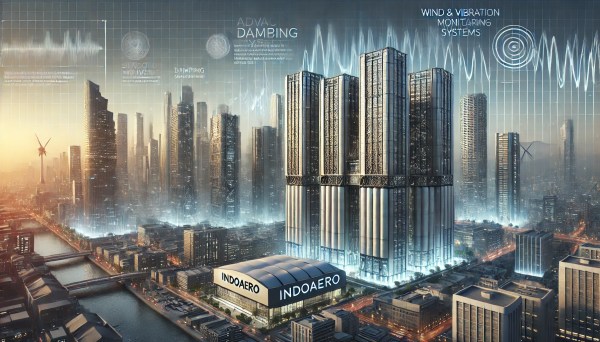
High-rise buildings are increasingly being constructed in urban areas worldwide, making accurate wind load estimation critical for structural safety and occupant comfort. Traditional wind load estimation relies on empirical formulas, wind tunnel testing, and computational fluid dynamics (CFD). However, these methods often require significant computational resources, time, and financial investment. Moreover, real-world wind conditions are complex, exhibiting nonlinear and stochastic behavior that conventional models struggle to capture. In response to these challenges, integrating data-driven methodologies and artificial intelligence (AI) into wind load estimation offers a promising solution. The estimation of wind loads on high-rise buildings is a critical aspect of structural engineering, particularly as urban environments evolve and the heights of buildings increase. Recent advancements in data-driven and artificial intelligence (AI) techniques have provided innovative methodologies for improving the accuracy and efficiency of wind load estimations. This synthesis explores various approaches that leverage computational fluid dynamics (CFD), machine learning, and hybrid models to enhance wind load predictions.
Understanding Damping in Tall Buildings: A Data-Driven Approach
Tall buildings are engineering marvels designed to withstand environmental forces such as wind and seismic activities. Among the key factors influencing their structural integrity is damping, a phenomenon that governs how a building dissipates energy from vibrations. Unlike mass and stiffness, damping is difficult to estimate due to the complex interplay of materials, frictional effects, and structural interactions. This article explores how a data-driven, probabilistic approach improves the understanding and prediction of damping behavior in high-rise structures.
Aeroelastic Energy Harvesting: A Game-Changer for Indonesia’s Renewable Energy Future
Indonesia, with its extensive coastline and archipelagic geography, holds significant potential for wind energy development. The country's wind energy potential is estimated at around 9.3 GW, primarily concentrated in regions like South Sulawesi, East Nusa Tenggara, and West Java. Coastal areas and highlands with average wind speeds between 4 to 6 m/s offer viable sites for small to medium-scale wind turbines. Notable projects like the Sidrap Wind Farm in South Sulawesi and the Tolo Wind Farm in Jeneponto highlight the possibility of harnessing this renewable resource. Together, these farms contribute approximately 150 MW of installed capacity, underscoring the early but promising stages of wind energy adoption in Indonesia. Despite the potential, Indonesia faces several challenges in expanding its wind energy sector. The moderate wind speeds in many areas limit the feasibility of large-scale wind farms, and high transmission costs arise from the remote locations of the best wind resources. Infrastructure limitations, particularly in rural and off-grid areas, complicate the integration of wind energy into the national grid. Additionally, complex land-use regulations and public resistance due to a lack of awareness about wind energy benefits create further obstacles. The financial environment for renewable energy projects also needs improvement, as investors often face regulatory uncertainties and limited incentives.
Wind Engineering Solutions for High-Speed Trains: Ensuring Safety and Efficiency Under Extreme Conditions
High-speed trains operate under various environmental conditions, including extreme wind scenarios that can significantly impact their safety and efficiency. The challenges posed by crosswinds and other aerodynamic forces necessitate comprehensive engineering solutions to ensure the operational integrity of these trains. One of the primary concerns in high-speed rail systems is the dynamic response of the... Continue Reading →
Adapting Wind Load Calculations for Climate Change: Resilient Building Design Strategies for a Safer Future
Climate change is increasingly recognized as a critical factor influencing building regulations, particularly concerning wind loads on structures. As climate patterns shift, the intensity and frequency of extreme weather events, including storms and high winds, are projected to increase, necessitating a reevaluation of existing building codes and standards. One significant aspect of this issue is... Continue Reading →
Revolutionizing High-Rise Design: How Wind Engineering Cuts Costs and Boosts Efficiency
The development of high-rise buildings requires meticulous design strategies to balance safety, functionality, and cost-efficiency. Wind load analysis, facilitated by wind engineering specialists, plays a critical role in achieving these objectives by optimizing material usage and mitigating wind-induced risks. This article explores the financial and structural benefits of incorporating advanced wind engineering techniques, including wind... Continue Reading →
The Critical Role of Wind Engineering in High-Rise Building Safety: Preventing Collapses and Enhancing Structural Resilience
High-rise buildings are vulnerable to wind-induced forces that can lead to catastrophic collapses if not properly addressed during design, construction, and maintenance. This article explores the critical role of wind engineering in preventing such failures, focusing on key factors such as wind load assessment, aeroelastic resonance, material fatigue, foundation stability, and dynamic amplification. Case studies,... Continue Reading →
Global Wind Load Standards: Comprehensive Guide to Building Safety Against Wind Forces Wind Load on Building
Wind load standards are essential frameworks developed by engineering authorities to ensure the safety and stability of buildings and structures against wind forces. These standards consider factors such as local wind speeds, terrain characteristics, building geometry, and dynamic effects to calculate the wind loads acting on structures. Due to differences in climate, geography, and construction... Continue Reading →
Vortex Induced Vibration on Building : Shenzhen Building Case study
The 356m-high SEG Plaza first began shaking on Tuesday afternoon (May 18), causing an evacuation of people inside while pedestrians looked on in horror run outside building. SEG Plaza is a skyscraper in Shenzhen, Guangdong Province, China. Completed in 2000 and located at the junction of Shennan Road and Huaqiangbei Electronics Market, it stands 356... Continue Reading →
How Wind Tunnel Testing Ensured Safety of the Iconic Musi VI Bridge in Indonesia
Musi VI Bridge is planned to cross the Musi River in Palembang City, South Sumatera Province, Indonesia. The main span is a steel arch type with 200 m length and side span length is 75 m. Finite element analysis results showed that the bridge has frequency ratio for torsional and heaving mode (torsional frequency/heaving frequency)... Continue Reading →