High-speed trains operate under various environmental conditions, including extreme wind scenarios that can significantly impact their safety and efficiency. The challenges posed by crosswinds and other aerodynamic forces necessitate comprehensive engineering solutions to ensure the operational integrity of these trains. One of the primary concerns in high-speed rail systems is the dynamic response of the... Continue Reading →
Revolutionizing High-Rise Design: How Wind Engineering Cuts Costs and Boosts Efficiency
The development of high-rise buildings requires meticulous design strategies to balance safety, functionality, and cost-efficiency. Wind load analysis, facilitated by wind engineering specialists, plays a critical role in achieving these objectives by optimizing material usage and mitigating wind-induced risks. This article explores the financial and structural benefits of incorporating advanced wind engineering techniques, including wind... Continue Reading →
The Critical Role of Wind Engineering in High-Rise Building Safety: Preventing Collapses and Enhancing Structural Resilience
High-rise buildings are vulnerable to wind-induced forces that can lead to catastrophic collapses if not properly addressed during design, construction, and maintenance. This article explores the critical role of wind engineering in preventing such failures, focusing on key factors such as wind load assessment, aeroelastic resonance, material fatigue, foundation stability, and dynamic amplification. Case studies,... Continue Reading →
Global Wind Load Standards: Comprehensive Guide to Building Safety Against Wind Forces Wind Load on Building
Wind load standards are essential frameworks developed by engineering authorities to ensure the safety and stability of buildings and structures against wind forces. These standards consider factors such as local wind speeds, terrain characteristics, building geometry, and dynamic effects to calculate the wind loads acting on structures. Due to differences in climate, geography, and construction... Continue Reading →
How Wind Tunnel Testing Ensured Safety of the Iconic Musi VI Bridge in Indonesia
Musi VI Bridge is planned to cross the Musi River in Palembang City, South Sumatera Province, Indonesia. The main span is a steel arch type with 200 m length and side span length is 75 m. Finite element analysis results showed that the bridge has frequency ratio for torsional and heaving mode (torsional frequency/heaving frequency)... Continue Reading →
Wind Resistant Design of Long Span Bridge at Big Indonesian Canyon
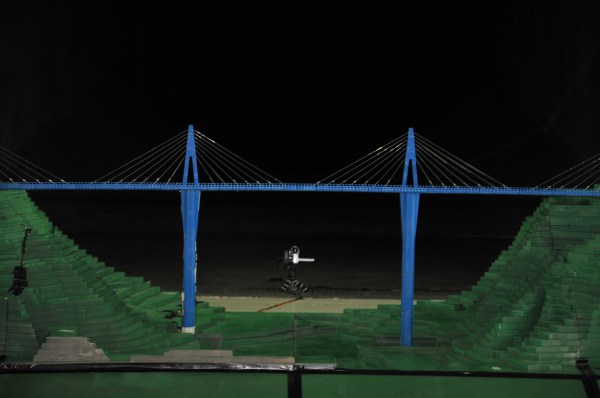
Ngarai Sianok Bridge consists of 3 main spans, each is 170 m. It also has 2 side spans with 87.5 m long. The two center pylons are 173.6 m tall while the height of other 2 pylons is 91 m. Deck is hybrid type that consists of prestressed box girder part, longitudinal steel stringer, cantilever... Continue Reading →
How to Suppress Resonance Induced Vibration at Bridge Structure
Flexible bridge is very sensitive with dynamics loading especially in dynamics wind load. Dynamics wind load can make the bridge vibrate with higher amplitude. Some phenomenon in structure failure because of wind dynamics loading is Tacoma narrow bridge which collapsed in 1940 at 18 m/s wind speed and Ferrybridge Power Station which had 114 m... Continue Reading →
Long Span Bridge Sectional Aeroelastic Wind Tunnel Testing
Wind tunnel test of a sectional model has becoming popular in long span bridge design processes. It is convenient to analyze the bridge deck aeroelastic behavior. The model is simple in structure, hence it can reduce the wind tunnel test cost accordingly, compare to full model. However, the model geometrical shape as well as structural dynamic properties... Continue Reading →